
Problem Solving
Manufacturing PVC Dryblend: Automating Raw Material Handling and Mixer Feeding
In the production of PVC dryblend, numerous raw materials must be precisely dosed, mixed, and reliably supplied. AZO’s plant solutions integrate raw material storage, pneumatic conveying, weighing, and mixer feeding into a coordinated process. This enables the production of different formulations and high batch frequencies in accordance with specific production requirements.
Precisely dose raw materials and reliably feed the heating-cooling mixer
PVC is pneumatically conveyed from outdoor silos to the main scale, where it is weighed. Additives, modifiers, stabilizers, chalk, and titanium dioxide can be weighed separately—depending on the plant design—and fed into the mixing process. This allows the individual formulation components to be dosed precisely, creating the conditions for reproducible mixing batches. Tailored feeding and weighing solutions are also available for liquid components and very small quantities.


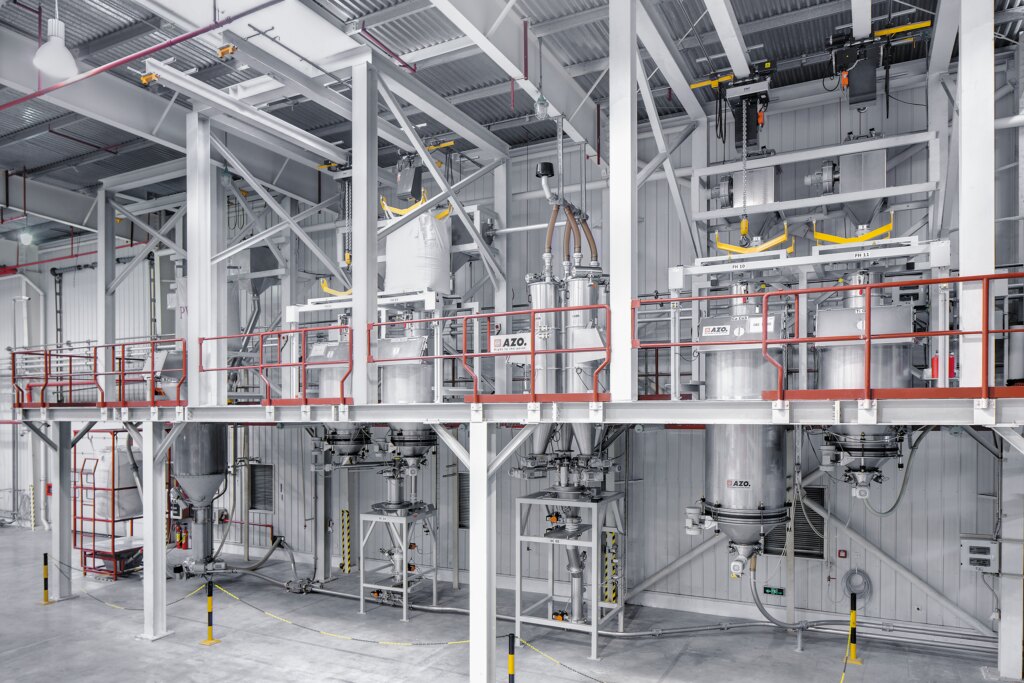


Flexible plant designs for a variety of production conditions
Whether it’s a low profile, ground-level raw material feeding, or the parallel feeding of multiple heating-cooling mixers: The systems can be adapted to spatial constraints, the variety of raw materials, and the required cycle rates. The AZO COMPONENTER®, for example, enables recipe-controlled, contamination-free collection of various components and their automatic transfer to the designated mixer. This supports flexible production with a wide range of raw materials and changing recipes.
Homogeneous Dryblend and reliable feed to the extruder
After the heating-cooling-mixing process, the PVC dry blend is conveyed to holding tanks and homogenization silos. The additional homogenization helps ensure consistent material quality. The finished dryblend is then transported to the extrusion lines via pneumatic conveying systems or bulk containers. This ensures that material supply is tailored to the subsequent production process.
The AZO process control and visualization system with PLC controls and monitors the plant, including the heating-cooling mixer. Formulations and production processes can be documented; for compatible plant designs, orders are imported via an ERP interface and feedback is transmitted to the ERP system. Remote maintenance also allows for remote access to the plant. This provides operators with greater transparency regarding raw material movements and production processes.


