Problem Solving
Turning Old into New – Recycling Plastics
We are witnessing a shift in thinking. Awareness of the finite nature of fossil fuels has grown significantly in recent decades, and the increasingly clear signs of climate change and environmental pollution have made it abundantly clear: We must learn to use our resources sparingly and sustainably. Plastics, in particular, have come under criticism in this regard, as they are usually made from petroleum and cannot be completely broken down naturally.
For this reason, we at AZO are deeply committed to the topic of recycling and the question of how plastics can be successfully processed and reused without suffering significant losses in quality. “Upcycling” is the key term here—that is, a form of recycling in which the reprocessing results in a product that is of at least the same high quality as, or even higher quality than, the original material. Depending on the type of raw material and the industry, this presents its own unique challenges.

Ultra-light materials—sticky and difficult to pour
So-called post-consumer recycling often involves polyolefin-based film packaging. These can come in a wide variety of forms and, in some cases, have widely varying flow properties. Depending on the pre-processing stage—that is, whether the products have been shredded, ground, washed, or sorted—different requirements arise for raw material automation.
Due to their low bulk density, one of the biggest challenges in handling ultra-light film scraps is the product feeding process. To address this issue, we at AZO have developed discharge solutions featuring agitators, vibrating floors, and special geometries that prevent the product from clumping or bridging.
The next challenge is emptying the separator. To address this, we have designed separators that feature particularly large outlet cross-sections and are free of obstructing contours. When used in conjunction with a pneumatic piston vibrator, even the lightest products can be reliably discharged.
Fibrous materials—difficult to flow and prone to clumping
Meanwhile, the market for recycled plastics continues to grow. The Israeli company UBQ, for example, has developed a filler made entirely from recycled household waste that can be used in a variety of ways to produce sustainable plastics.
To achieve this, the filler must be incorporated into the plastics manufacturing process, which poses a real challenge for automated handling. This is becauseUBQTM—and fibrous raw materials in general—have poor flow properties and tend to form bridges and become entangled.
Here, too, AZO offers suitable discharge systems and feed hoppers to feed the product into the process as safely and efficiently as possible.

Abrasive Grinding Media – Wearing and Harmful to Health
In the manufacturing sector, recycling one’s own production waste is usually already standard practice. DEKURA Kunststoffrecycling, however, goes a step further by collecting offcuts from window production as well as old windows and roller shutters from across Europe and processing them. In this way, production waste is transformed into high-quality secondary raw materials that can then be reused in the production of window profiles.
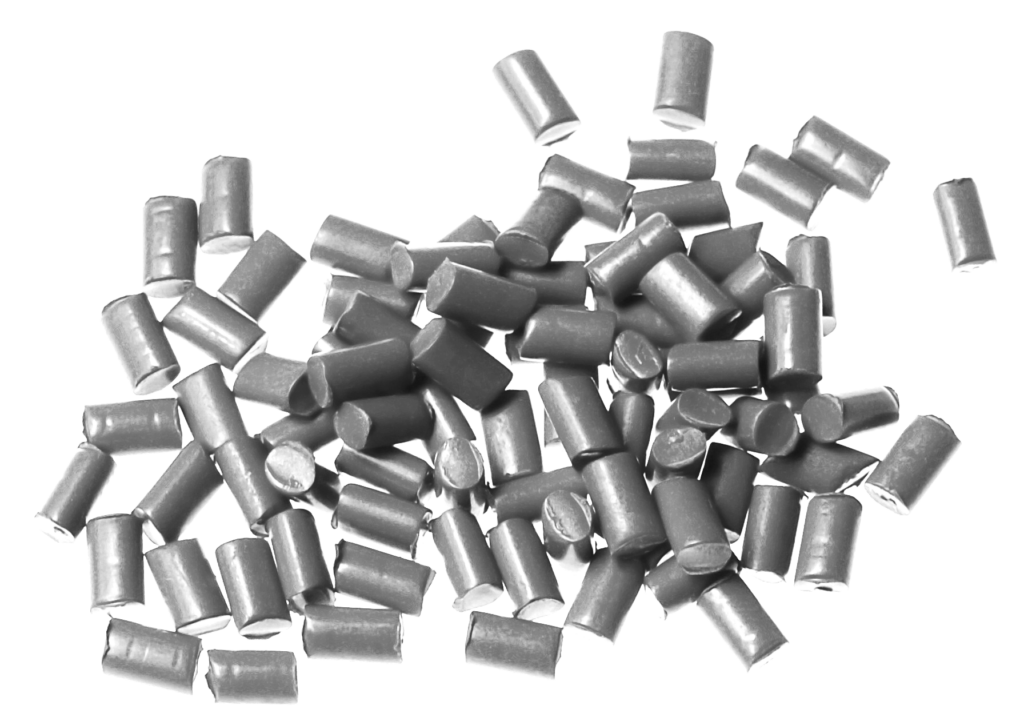
To do this, the window scraps are shredded, ground, and, through several sorting steps, the PVC is separated from the glass and hardware and then washed. They are then processed into clean PVC granules that can be used in the production of new windows.


